
Teton County Release Date Types
Teton County has no adult jail building. A local detainee may be held by Madison or Jefferson County under a contract arrangement. The holding jail records the physical stay, but the Teton court supplies bond, dismissal, judgment, sentence, and commitment orders. A felony commitment to IDOC ends the county booking through transfer. It is not release to the community.
For a state client, the IDOC Resident/Client Search uses precise labels. It does not promise one universal Projected Release Date field. Parole Eligibility Date, Next Parole Hearing Date, Sentence Satisfaction Date, and Released to Supervision each answer a different question.
| Date | Meaning |
|---|---|
| Parole Eligibility Date | The earliest parole consideration point, not approval. |
| Next Parole Hearing Date | Expected review timing that can change. |
| Tentative parole date | A conditional Commission action subject to required steps. |
| Sentence Satisfaction Date | The endpoint shown for an active sentence. |
| Released to Supervision | The past date of placement on court or Commission supervision. |
| Jail release timestamp | The physical booking exit or transfer time recorded by the jail. |
Find Teton County Release Dates
Start with custody type. Applying a prison formula to a county detainee gives a false answer. Likewise, a jail roster cannot calculate an IDOC sentence. The court case is the bridge when the present custodian is uncertain.
- Search iCourt for the Teton case and read bond, judgment, sentence, commitment, and amended orders.
- Ask the Teton Sheriff which contract jail received a local detainee on that booking date.
- For a county sentence, request the judgment, jail-credit order, booking ledger, and release calculation from the court and holding jail.
- For an IDOC commitment, search by last name or IDOC number and match the correct age and identifier.
- Read overall status, physical location, each sentence row, PED, hearing date, satisfaction date, and Released to Supervision.
- Check Commission decisions if parole was considered, but keep a tentative grant separate from actual release.
- Ask IDOC Sentencing Records for the authoritative calculation when fields conflict or the public screen is incomplete.
The Teton County released-inmate records path explains how to obtain the local booking and court documents that remain after a person leaves a current roster.
Teton County IDOC Date Fields
The IDOC search accepts a required last name or IDOC number, with optional first name. At least two last-name characters or three IDOC-number digits can begin a search. On a detail page, “In custody” normally has an institution address. “In community” normally has a district, officer, and phone. An “In community” record can still show a county-jail physical location after a new arrest or violation, so all fields must be read together.
The official in-custody example illustrates parole eligibility, hearing, and sentence-satisfaction fields.
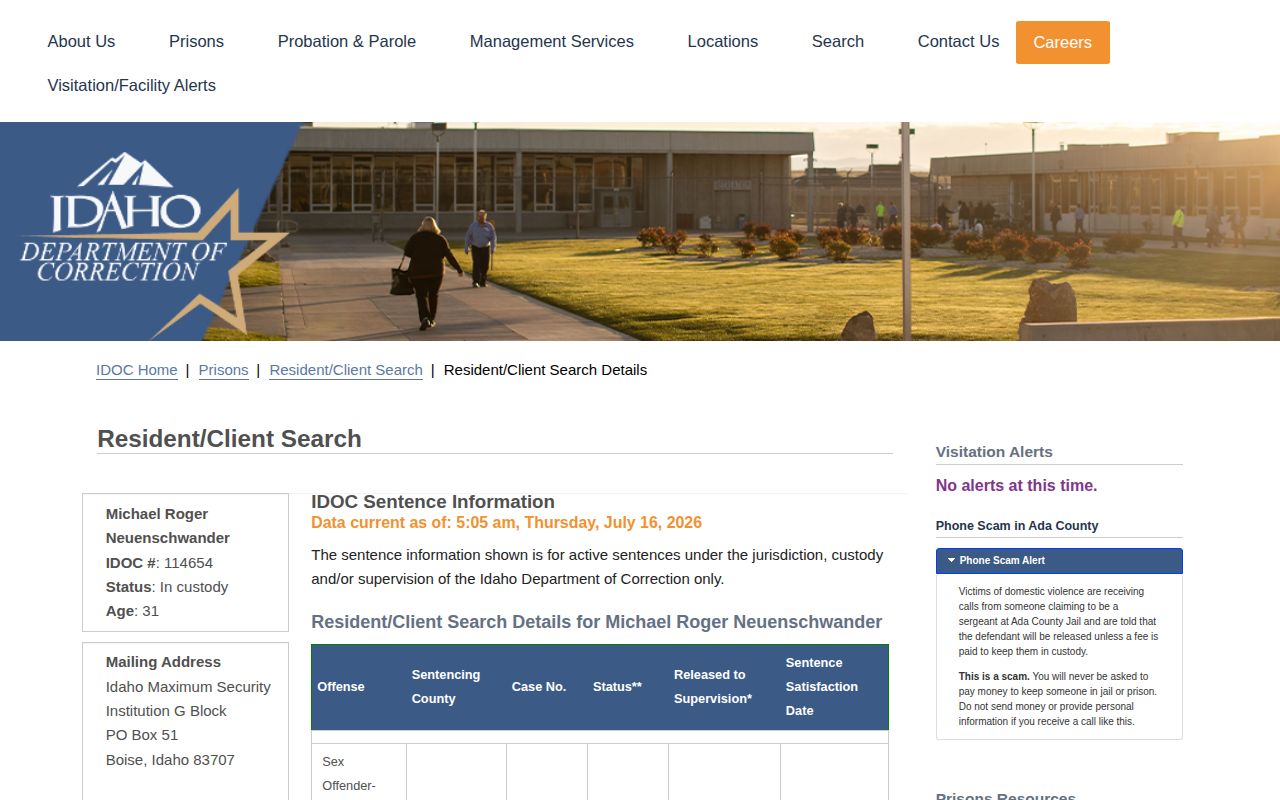
The example shows why a hearing or eligibility date should not be restated as the day someone will leave prison. IDOC warns that status, location, and scheduled information can change quickly, even with daily updates.
Idaho Has No 85% Rule
Idaho should not be described with a generic “serve 85 percent” formula. Under Idaho Code section 19-2513, the court imposes a unified sentence with a determinate minimum followed by an indeterminate part. The person ordinarily is not eligible for parole or discharge during the fixed minimum. Consecutive fixed terms can delay the start of parole consideration.
Modern Idaho law also lacks a broad routine earned-time reduction. Section 20-101D permits narrow meritorious reduction for extraordinary heroism or outstanding service, within statutory limits, and an award can be withdrawn. Older good-conduct provisions concern offenses before July 1, 1986 and must not be applied to a modern Teton sentence.
Parole is discretionary. Reaching the fixed-term endpoint opens consideration when the judgment and offense rules permit it, but does not create a right to leave. Fixed life, life without parole, mandatory terms, and offense-specific limits require case-by-case reading.
Teton County Jail Calculations
No official Teton, Madison, or Jefferson county good-time or weekend-release policy was found. Do not borrow a policy from another Idaho county. For a local term, the judgment, jail-credit order, booking ledger, and the holding jail's actual calculation control. Request that existing calculation instead of asking staff to create a forecast.
A pretrial detainee may have no fixed release date because bond, dismissal, plea, sentencing, a new hold, or transfer can change the path. A bond order authorizes release, but the contract jail records when processing finished. The same distinction applies after sentence completion. The court states the authority; the jail supplies the door-out or transfer timestamp.
Teton's shifting contract history makes the booking date vital. Madison currently says it houses Teton people, while a sworn June 2024 Teton declaration identified Jefferson as the contractor then. Ask Teton where the person was sent before requesting a calculation.
Changes to Teton Release Dates
A projected date can move for legal, administrative, or custody reasons. The cause should be traced to a record rather than guessed from a changed web field.
| Change | Record to check |
|---|---|
| Amended judgment | Teton court docket and signed order |
| Jail credit correction | Credit order and IDOC Sentencing Records |
| Concurrent or consecutive terms | Judgments and sentence calculation |
| Parole denial or later review | Commission Notice of Action Taken |
| Program or release-plan delay | Commission decision and IDOC status |
| Violation or forfeiture | Commission action and sentencing record |
| Detainer or new hold | Jail destination, warrant, or receiving-agency record |
An immigration detainer or another county warrant can close one booking through transfer while confinement continues. Ask for release type and destination. For a later alert, use the Teton County VINELink Release Check, but confirm an alert with the custodian.
Teton County Sentencing Records
IDOC Sentencing Records reviews judgments, calculates terms and release eligibility, applies jail and retained-jurisdiction credit, processes parole forfeiture, and maintains official sentencing records. It cannot change a court sentence or give legal advice. A narrow request may seek the sentence-calculation report, release-to-supervision record, satisfaction record, or correction of an online error.
Use the IDOC request portal and include name, IDOC number, sentencing county, case number, and date range. For Commission material, ask for the Notice of Action Taken or final discharge record. A final discharge notice can take time to arrive through the last supervision district.
- Determinate term
- The fixed minimum confinement set by the Idaho court.
- Indeterminate term
- The later portion during which parole may be considered.
- PED
- Parole Eligibility Date, which is not a promised release.
- Sentence satisfaction
- The recorded endpoint of the active sentence.
- Detainer
- A request or hold tied to another authority that can affect destination.
Note: Use the exact date label in any request, since “release date” alone can refer to several different Idaho events.
Teton County Unified Sentences
Idaho's unified sentence has two parts that must remain distinct in any Teton County release-date estimate. The determinate part is the court-set minimum period of confinement. The indeterminate part follows it and creates the span in which parole may be considered, subject to the judgment and governing law. The full sentence is not reduced to a simple percentage. Reading only the maximum or only the minimum can create a false date.
Consecutive sentences add another layer. Consecutive determinate terms affect when the indeterminate portions and parole consideration begin. Concurrent terms can overlap, but the signed judgments and IDOC calculation decide the result. Jail credit and retained-jurisdiction credit also require the official record. A calculator built from sentence headlines cannot safely resolve those inputs.
The Commission decides parole; it does not rewrite the court's sentence. Eligibility opens the possibility of review, while denial can leave the person confined for later review or through the applicable term. A tentative grant remains conditional. The actual release-to-supervision entry comes later if all release steps are completed.
Teton County Jail Release Timing
A local jail term does not use the public IDOC date labels unless the person has also entered state jurisdiction. Begin with the Teton judgment and any order awarding time already served. Then ask the actual holding jail for its booking ledger and release calculation. No researched official source published a Teton, Madison, or Jefferson weekend-release rule, routine good-time policy, exit hour, or standard processing delay. Those facts must be confirmed for the individual event.
Pretrial custody is even less suited to prediction. Bond can be posted, a judge can change conditions, charges can be dismissed, another hold can appear, or a different authority can take custody. A court order may set the legal basis for release, while the jail still must finish checks, property handling, and any transfer. The physical timestamp belongs to the jail record.
Because Teton's contract arrangement has changed, the name of the custodian is date-sensitive. The Teton Sheriff's Office can identify the receiving jail from its arrest or transport file. Madison or Jefferson can then locate the physical booking. A request sent only to Teton may miss the door-out field, while a request sent only to a contract jail may miss the Teton court or transport identifier.
Teton County Tentative Parole Dates
The Commission describes parole dates as tentative. A person cannot release before the stated date, but reaching it does not force release. Required programming must be complete, IDOC must approve the parole plan, transportation must be arranged, and the parole contract must be finalized. A proposed residence can require investigation by the district that will supervise the client.
The hearing schedule and decision notice track consideration, not the prison gate event. After the hearing, read the exact outcome. A grant, denial, reconsideration, later review, reinstatement, revocation, or pass to full term changes the path in a different way. Later, use IDOC Released to Supervision to confirm that community placement occurred.
A violation can change later dates as well. Parole forfeiture, an amended judgment, corrected jail credit, or a new consecutive term can alter the authoritative calculation. IDOC Sentencing Records processes these changes. When the web display and court papers disagree, request the calculation rather than choosing the date that appears most favorable.
Teton County Court Date Checks
The Teton clerk's public case record can preserve release-related authority after a jail list no longer shows the booking. Search for bond orders, dismissal, judgment, commitment, probation, amended orders, and satisfaction entries. The court record is strongest for what the judge ordered. It is not the source for the precise time a detention officer completed release or transfer.
Use the case number to connect the sources. Give it to the Teton Sheriff when asking which contract jail handled the booking, and include it in the holding-jail request. For a state commitment, match the Teton case number and Sentencing County field in IDOC. This reduces the risk of attaching a same-name person's projected date to the wrong case.
Sealed, confidential, juvenile, and some older material may not appear publicly. When the portal is incomplete, ask the clerk for the releasable register of actions and signed order. For an IDOC calculation, request Sentencing Records instead of asking the clerk to interpret correctional dates. The clerk, jail, Commission, and IDOC each control a different part of the timeline.